Congratulations to Zhao Zhang for his paper accepted by ACS Applied Materials & Interfaces!
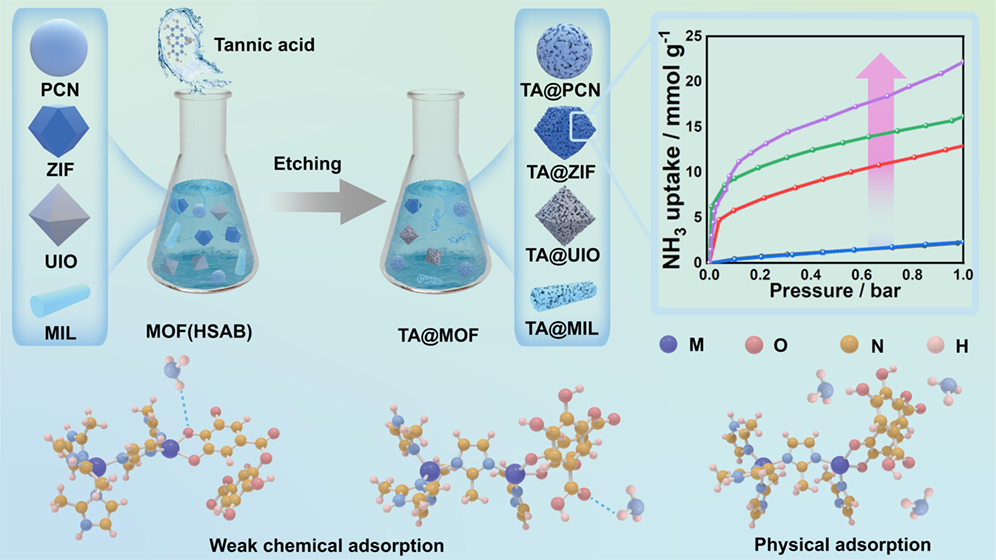
The development of efficient and reversible ammonia (NH3) adsorbents is crucial for advancing ammonia fuel cell technology. Key challenges in the ammonia adsorption–desorption process include achieving high uptake/release efficiency, favorable kinetics, and stable cycling lifetime. Herein, we report a strategy to prepare high-performance ammonia adsorbents by partially etching metal–organic frameworks (MOFs) with tannic acid (TA). Partial etching by protonated TA not only exposes metal active sites but also chelates metal ions, significantly enhancing both the adsorption capacity and the stability during adsorption–desorption cycles. This strategy retains the high specific surface area of the micropores and the chelating functional groups while alleviating premature pore blockage caused by capillary condensation of ammonia on the material surface, thereby improving adsorption kinetics. The partially etched ZIF-67 achieves a reversible capacity as high as 58 mmol g–1 at 298 K and 7 bar, theoretically corresponding to a hydrogen content of 7.5%. The generated hierarchical pore network facilitates ammonia desorption, reducing the temperature and energy required for regeneration, with complete desorption achieved at 364 K. Moreover, the partially etched MOF exhibits excellent ammonia adsorption selectivity, offering a new approach for the purification of industrial exhaust gases. In situ infrared spectroscopy and theoretical calculations reveal that the enhanced adsorption arises from weak chemisorption, benefiting from an increased density of adsorption sites within the engineered pore environment. This strategy provides a new avenue for designing integrated, efficient, and safe systems for ammonia fuel storage and release.