Congratulations to Shuangshuang Yao and Teng Wang for their paper accepted by Applied Catalysis B: Environment and Energy!
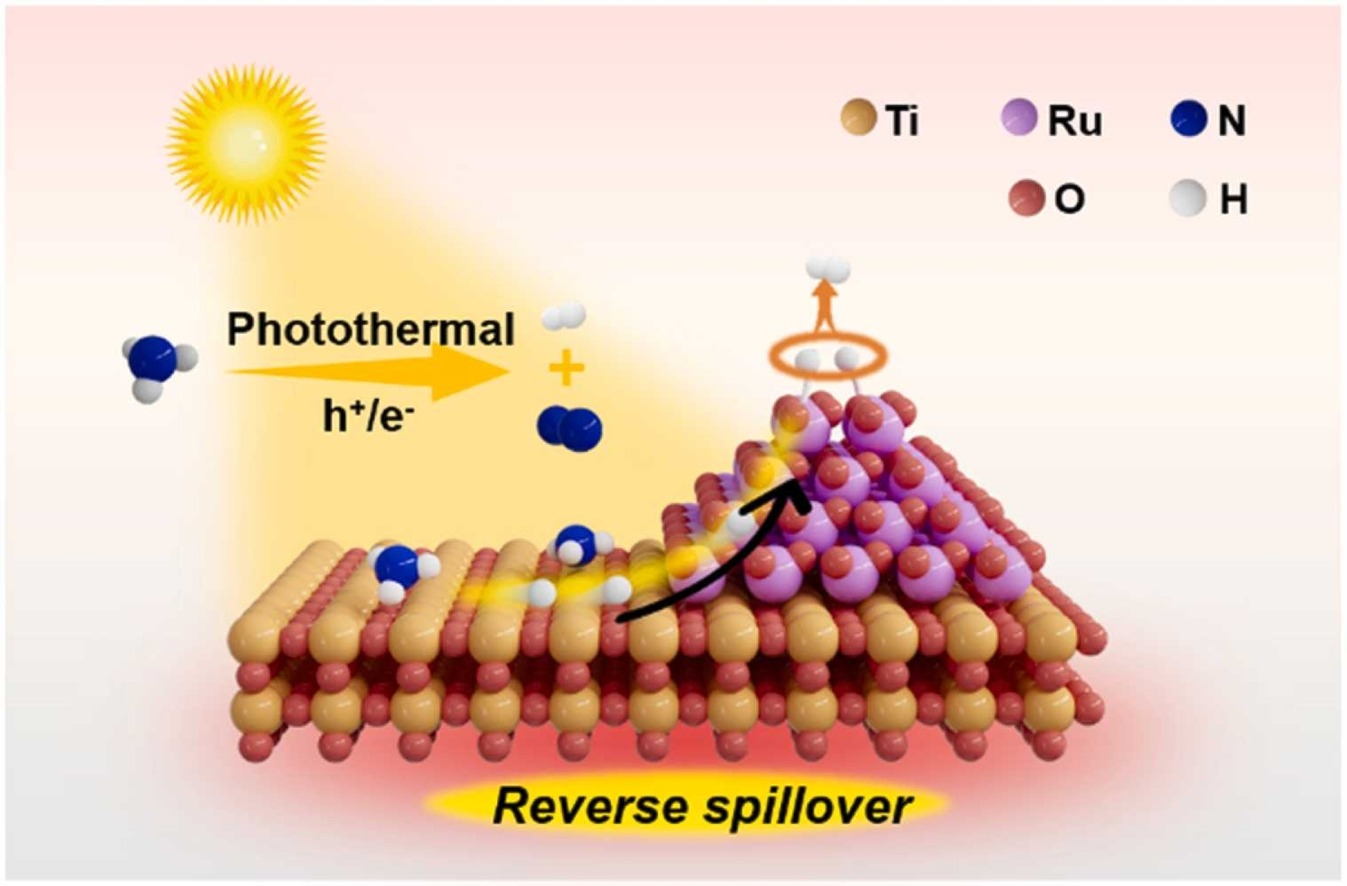
Ammonia (NH3), a pivotal carbon-free energy carrier, suffers from kinetic limitations during catalytic decomposition due to hydrogen poisoning of ruthenium (Ru) active sites—a persistent challenge causing rapid activity decay and durability loss. Here, we demonstrate an innovative strategy to circumvent hydrogen poisoning by engineering a reverse hydrogen spillover pathway at RuO2/TiO2 heterointerfaces. Unlike conventional designs with forward spillover (Ru-to-support), this dual-site catalyst activates N–H bonds on TiO2 while the interface regulates reverse spillover of reactive hydrogen to Ru sites (support-to-Ru), thereby spatially decoupling ammonia activation from hydrogen accumulation. This pathway streamlines Ru’s role in the catalytic cycle, achieving exceptional catalytic efficiency under mild conditions (300 °C and 2.5 W cm−2) with H2 production rates reaching 10.17 mmol g−1 min−1. We suppose that the interfacial synergy between RuO2 and TiO2 activates the dissociation of NH3 on TiO2 under illumination, which may be the underlying cause of reverse hydrogen spillover. Our work highlights the critical role of reactive hydrogen management in ammonia decomposition, offering a robust approach toward efficient, poison-tolerant hydrogen production.