Congratulations to Teng Wang for his paper accepted by Journal of the American Chemical Society!
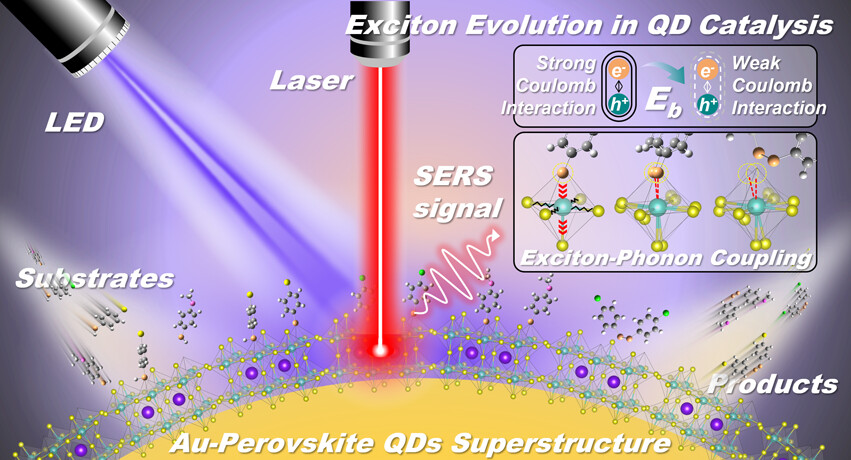
Semiconductor quantum dots (QDs) have emerged as a paradigm-shifting catalytic platform for visible-light-driven organic synthesis, owing to their highly tunable excitonic properties. However, the critical role of nanoconfined exciton evolution in governing surface reactions remains experimentally elusive. Here, we synthesized Au@perovskite QD superstructures for in-situ surface-enhanced Raman spectroscopy to probe exciton-molecular crosstalk during the photocatalytic self-coupling of aromatic thiols on QD surfaces. We find that quasi-ligand coordination of thiols with surface Pb sites simultaneously attenuates three exciton relaxation pathways: radiative recombination, Auger recombination, and exciton–phonon coupling, while enhancing trap-assistant recombination. Thermodynamically, coordinating molecules with varying substituent groups reduce the exciton binding energy (Eb) in QD systems through their tunable dipole moments. This excitonic modulation effectively lowers the activation barrier during the reaction and thus facilitates S–S bond coupling, as demonstrated by substituting −Cl with −OCH3, which reduces Eb by 38.3% and increases the reaction rate by 84.7%. Our work reveals exciton-molecular crosstalk as a key mechanistic aspect in QD catalysis and enriches the theoretical framework of heterogeneous catalytic processes under quantum confinement.