Congratulations to Aonan Zhu for his paper accepted by eScience!
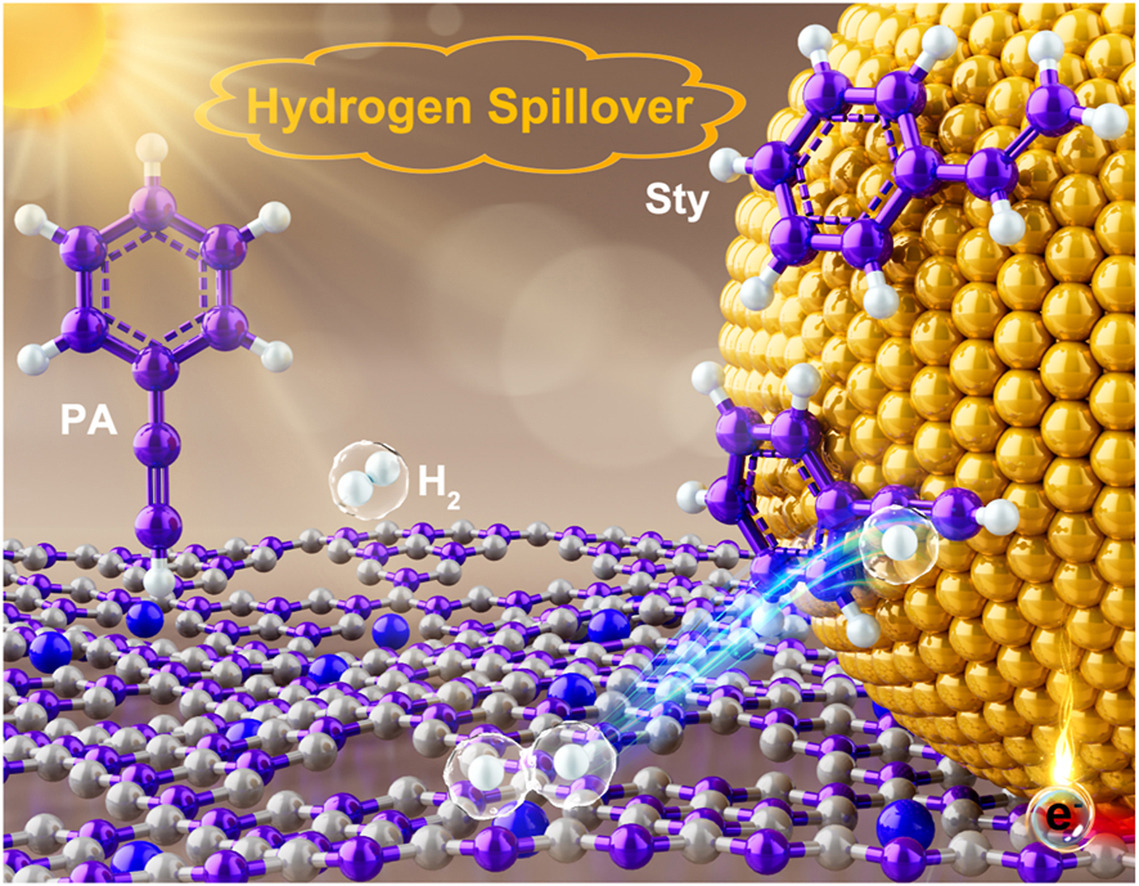
Facile reactant dissociation and weakly bound intermediates are essential for achieving both efficient and selective catalysis. However, these two factors are inherently interconnected, making their simultaneous optimization particularly challenging. Herein, we propose a decoupling strategy to circumvent this limitation and demonstrate it using a novel antenna-reactor catalyst constructed with single atom and plasmonic nanoparticles. By combining in situ surface-enhanced Raman spectroscopy with density functional theory calculations, we reveal that nonequilibrium carriers significantly enhance hydrogen dissociation at Pd single-atom sites. Subsequently, these active hydrogen atoms spillover to adjacent Au surfaces, facilitating more favorable alkyne hydrogenation and alkene desorption processes. Consequently, the Pd SAC-Au photocatalyst exhibits remarkable catalytic performance, achieving a turnover frequency value of 3964 molC=C molPd-1 h-1 and demonstrating 99.99% conversion of phenylacetylene with 90% selectivity toward styrene under mild reaction conditions (298 K, 101.3 kPa). This approach offers a novel pathway to overcome traditional catalytic trade-off, highlighting the potential for designing high-performance single-atom catalysts for chemical reactions.